

 EN
EN  NL
NL
 DE
DE
 FR
FR

Coastal and Hillside Walks from Grimaud
Grimaud sits in a sweet spot of the Var: medieval stone lanes climbing toward a ruined castle on one side, a labyrinth of canals and sandy shores in Port Grimaud on the other, and the wild, aromatic folds of the Massif des Maures rising behind everything. If you’re in the mood to set off on foot, you can lean toward the sea for breezy boardwalks and the classic Sentier du Littoral, or step inland for cork oak shade, ridge views, and time-polished paths between chapels and windmills. This guide gathers the best coastal and hillside walks you can do from Grimaud and nearby, with a friendly mix of routes you can stroll before lunch and full-day adventures for when you feel like earning your rosé at sunset.
Getting Oriented: Sea, Village, and the Maures Ridge
Think of Grimaud in three layers. On the water, Port Grimaud’s canals open onto the Gulf of Saint-Tropez, with long sandy strands west toward Sainte-Maxime and more secluded coves east toward Saint-Tropez and Les Salins. Above the shore, the original stone village of Grimaud spreads across a south-facing slope, watched over by a medieval castle and a restored windmill. Beyond that, the Massif des Maures rolls inland in evergreen hills of cork oak, strawberry tree, and heather, crisscrossed by old mule tracks, charcoal paths, and ridge routes that deliver big views of the sea and the Alps on especially clear days.
Distances are friendly. Many coastal walks begin with a short amble through Port Grimaud’s lanes and across sandy stretches like the Plage de Port Grimaud or the quieter coves near the entrance channel. Hillside routes start right from the village center: a ten-minute slope takes you to the castle; twenty minutes more puts you among cork oaks on the way to Notre-Dame de la Queste. For wilder coastlines (Cap Camarat, Cap Taillat, and Cap Lardier) or higher Maures summits (near La Garde-Freinet and Collobrières), plan a short drive to a trailhead—then leave the car and let your feet do the rest.
When to Walk: Light, Wind, and Seasonal Rhythm
Winter brings crisp air and quiet paths; spring paints the maquis with cistus, thyme, and golden broom; summer rewards early starts and post-walk swims; and autumn is luminous, with warm seas and less-crowded trails. The mistral, a brisk northwesterly wind, can make a sunny January day feel sharper and also scrub the sky crystal clear. In high summer, coastal routes are best at dawn or late afternoon, when the light is soft and the pine shade feels like a gift. Forest access in the Var is regulated for fire risk from June through September; on “red” or “black” danger days some Maures trails are closed. Check the day’s forecast and signage at trailheads, and favor the coast when the backcountry is restricted.
What to Pack and How to Prepare
Footing on the coastal path can change from compact sand to roots and stone ledges in a single bay, so comfortable walking shoes or light hiking shoes are a good idea. For hillside routes, consider grippy soles; the old cobbles and schist can be slick after dew or rain. Bring more water than you think you need—especially in summer—a hat, sunscreen, and a light wind layer if you’ll be exposed along ridges. A small towel and swimsuit turn every coastal outing into a swim-and-walk day. An IGN map (3545 OT covers the Gulf of Saint-Tropez) or a reliable map app helps with the maze of small lanes and tracks above the village. On forest paths, keep a simple kit: a bandage, insect repellent, and a flashlight if you like sunrise or sunset walks.
Public transport can help you mix routes: local buses connect Grimaud, Sainte-Maxime, and Saint-Tropez, and in season there are sea shuttles across the gulf. Even if you have a car, it’s liberating to start in one place and end in another without worrying about a return loop. That said, many walks described here are comfortable circuits that bring you back to your starting point.
Village Classics: Short Walks You Can Do Before Lunch
Pont des Fées and the Garde Valley
If you only have an hour and want a taste of Grimaud’s oldest stones and gentlest nature, follow the path down to the Pont des Fées, a medieval aqueduct bridge tucked in a green fold on the Garde stream. The route begins in the village and slides past stone terraces, tiny oratories, and gardens of rosemary and lavender before dropping into the cool of the valley. The bridge itself, with its soft arches and lichen-covered blocks, looks like it was placed there by hand yesterday. Listen for water trickling under the arch after rains, and look for dragonflies skimming the surface in spring and early summer.
Insider tip: a few steps beyond the bridge, a narrow path leads onto a flat rock shelf where locals sometimes pause for a quiet picnic. The valley is surprisingly birdy; keep an ear out for blackcaps, serins, and the scratchy call of the Sardinian warbler in the shrubs. If you make it a loop, you can climb back into the village along the old washhouse and fountains. The lavoir below the village is still a gathering point on summer afternoons.
Up to the Château and Moulin Saint-Roch
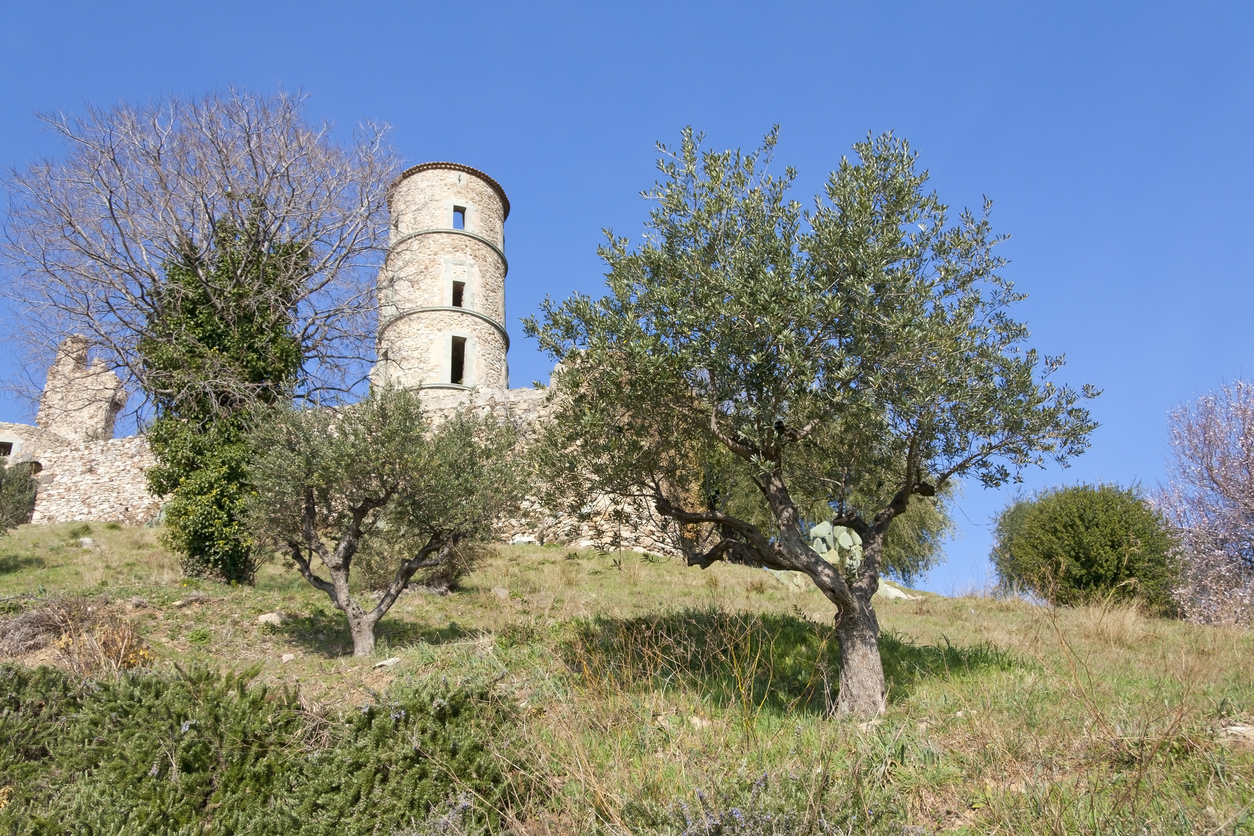
The castle ruins above Grimaud are visible from just about everywhere, but walking up to them turns the whole Gulf into a panorama. Follow the steps from the center toward the Eglise Saint-Michel, a 12th-century Romanesque church whose cool nave is a welcome pause on hot days. From the church, a winding lane leads to the castle. Inside the ruined walls, the wind funnels through grass and thistle; climb the ramparts and you can trace the lazy curve of the coast from Sainte-Maxime to Saint-Tropez. Continue along the crest to reach the restored Moulin Saint-Roch, a windmill with a wooden cap and sails that sometimes turn for demonstrations. The stone bench beside the mill makes a perfect place for a mid-morning snack with a view.
Insider tip: from the windmill, a faint path runs along the ridge for a few minutes to a boulder that locals call the “fauteuil,” a natural seat with the Gulf framed between pines. It’s one of the quietest sunset perches in the area.
Notre-Dame de la Queste and the Cork Oaks
This serene chapel stands on a small plateau north of the village, surrounded by cork oaks and umbrella pines. The best approach is a gentle climb through stone-walled terraces and over patches of schist, fragrant with rockrose and thyme in spring. Near the chapel, look for a few dry-stone huts—simple circular shelters that shepherds and vineyard workers once used to escape the heat or a passing shower. The grounds host a popular pilgrimage and fair each year, but most days you’ll find only a couple of walkers and the rustle of the wind in the pines.
Insider tip: the bark on the cork oaks shows harvest marks—freshly stripped trees are deep cinnamon, while older scars darken to charcoal. You can sometimes spot numbered tags on trunks indicating harvest cycles. Please resist the temptation to peel bark; it’s a skilled job done on a nine-year rotation.
Vineyards and Country Lanes: The Val de Gilly Loop
For a mellow half-day out, trace the lanes and tracks of the Val de Gilly, a patchwork of vineyards, olive groves, and small streams east of Grimaud. Begin on quiet roads lined with dry-stone walls, then slip onto farm tracks that pass between rows of grenache and rolle grapes. In May and June, wildflowers light the verges—pinks of cistus, yellows of broom, the burst of wild fennel; in September, the air is sweet with crushed grape skins and fermenting juice. Small chapels appear along the way, sometimes open, sometimes simply a whitewashed facade with a wooden door weathered silver by the sun. Keep an eye out for tiny shrines tucked into the walls—saints guarding a curve, a crossroads, or a spring.
Lesser-known detail: a short spur near the stream leads to a modest stone bridge with a carving so worn it looks abstract. Locals say it once depicted a fish, a nod to the stream’s past as a source of water for mills and gardens. Even if the carving is now a smudge, the spot has a hush that invites a five-minute pause.
Coastal Path West: Port Grimaud to Sainte-Maxime
West of Port Grimaud the coast sweeps gently, with wide beaches punctuated by rocky peninsulas that hold pockets of old pine and sea holly. The official Sentier du Littoral dips in and out; even when you’re on promenade or boardwalk for a stretch, you can always return to the edge where the waves lap over sand.
From Port Grimaud to the Sardinaux Peninsula
Start at Port Grimaud and walk the beach toward Sainte-Maxime, letting the sand firm under your toes near the waterline. You’ll pass beach groves and chattering sparrows around tamarisks before the coastline turns rockier near the Sardinaux peninsula. Sardinaux is a small world of its own: a low rocky headland with tide pools, stone pines bent by wind, and the remains of a wartime casemate half-concealed by shrubs. In calm weather the pools brim with tiny fish and sea anemones. On breezy days the air is salty and clean, and the views across to Saint-Tropez sparkle.
Insider tip: on the peninsula’s seaward side, there’s a ledge no wider than a bench with just enough room for two. It’s a fine place for a thermos coffee at sunrise. Near the base of the headland, a small grove hides a memorial stone that locals leave pebbles on; it’s easy to miss if you’re moving too fast.
Quiet Corners between La Nartelle and La Madrague
Continue west and the rhythm turns to long beaches bordered by pines, with breakwaters where you can step out and watch cormorants diving. Between La Nartelle and La Madrague the path weaves between sand and low stone. Early morning, the fishermen on the rocks swap stories, and you’ll often spot a heron posted like a sentinel, hoping for a free breakfast. In late afternoon the scent of pine resin is strong, and the sea takes on deeper blues and greens. Choose a sheltered cove for a quick swim before looping back or riding the bus to shorten your return.
Lesser-known detail: at the western end of La Nartelle, the beach pebbles include rounded chips of pale schist with glittering mica—children love searching for the sparkly ones. Be mindful not to collect bagfuls; leave the coastline as you found it.
Coastal Path East: Port Grimaud to Saint-Tropez and Les Salins
Eastward, the shore grows more intricate: sandy folds yielding to rocky shelves, pine groves giving shade between coves. It’s also the way to the fishermen’s world that survived in pockets around Saint-Tropez—boathouses, nets drying, and the smell of tar and salt that clings to old wood.
Bouillabaisse Beach to Canoubiers: Pine Shade and Fishermen’s Sheds
From the Bouillabaisse side of Saint-Tropez, the coastal path picks up behind the beach and winds toward the sheltered arc of Canoubiers Bay. This is one of the easiest sections of coastal walking anywhere in the gulf: mostly flat, with the path ducking in and out of pine shade, and constant views of boats at anchor. Once you turn the corner into Canoubiers, look for the fishermen’s sheds and the timber rails used to winch boats ashore. Off to the side, the maritime cemetery quietly watches the water; the graves face the sea, and the breeze seems to hush as you pass.
Insider tip: midweek mornings outside peak season, you’ll often have the path almost to yourself. Stop where the sand thins to pebbles near the end of the bay and scan the water for mullet flashing in shallow schools. In late spring and early summer, swallows stitch the air above the ponds behind the pines.
Beyond Town: Pointe des Salins at Dawn
Past the headlands east of Saint-Tropez, the Pointe des Salins offers a feeling of the open sea. The rock slabs here are worn smooth, with shallow basins that fill at high water and warm quickly in the sun—a natural paddle pool for children. The beach often collects banks of posidonia leaves, the ropy seagrass that binds sand and shelters juvenile fish. It’s not debris; it’s a sign of a healthy coast, and it helps protect the shore in storms.
Lesser-known detail: above the point, traces of an old battery remain—low walls and a half-buried platform. The position was chosen for a reason: you can see in both directions along the coast, and on clear days the islands off Hyères appear faintly on the horizon. If you go at dawn, the rocks glow pink, and the only sound is the hush-shush of small waves. Bring a towel; most walkers end up staying longer than planned.
Day Trips for Wild Coasts: Caps Camarat, Taillat, and Lardier
These three headlands form a protected stretch of coast with some of the most rewarding walking anywhere in the Var. They’re an easy outing from Grimaud: drive to a trailhead near Ramatuelle or La Croix-Valmer, then choose your adventure. Long sleeves are useful even in summer for brushy sections, and the water is so inviting that almost every route becomes a swim hike.
Cap Camarat Lighthouse Circuit
The lighthouse at Cap Camarat stands on a knuckle of schist, high enough to feel dramatic but still close to coves that look made for postcards. A good circuit loops from the car park past low walls of a former signal station, then drops to a cove where the water is gin-clear and wrasse dart in and out of the rocks. From there, climb to the lighthouse fence line, where an orientation table helps you pick out features of the coast. Aromas change as you walk: juniper, wild thyme, the honeyed scent of immortelle crushed under boot.
Insider tip: a few hundred meters from the lighthouse, look for a path branching to a notch where you can peek down at a tiny inlet nobody ever seems to visit. The stone there glitters gold in late afternoon—the perfect place to take a breath before finishing the loop.
Cap Taillat Neck and Hidden Snorkeling Coves
Cap Taillat is a thread of sand and rock connecting a small island-like promontory to the mainland. The approach is classic: beach to pine woods to open scrub to narrow isthmus. On either side of the neck, the water is shallower and often calmer than the surrounding sea—excellent for snorkeling on days with light swell. Fields of posidonia ripple below, and if you’re patient you might spot a sea bream nosing along the edge. The round trip can be as short as two hours if you simply cross the neck and loop back, or it can become a relaxed day with swims, picnic naps, and a wandering return on higher paths with views back toward the gulf.
Lesser-known detail: behind the dunes, a small depression holds water well into spring; it’s a temporary pond where toads chorus after rains. If you’re walking in March or April at dusk, you might hear them above the sound of the sea.
Cap Lardier Ridge for Big-Sky Views
The Cap Lardier area offers a choice between coast-hugging paths and a ridge track with wider horizons. The ridge route rolls over low bumps and opens to sweeping views: the gulf spread out to the east, the open Mediterranean south, and if you turn inland you’ll catch the gentle wave of the Maures all the way toward Collobrières. The descent to the shore is a delight—twisting through stuffed maquis where the shrubs brush both shoulders. Bring patience and a camera; the lighting late in the day is soft and painterly, and you’ll want to stop often.
Insider tip: there’s a flat rock above a cove on the east side that locals nicknamed “the table.” It really does serve as a natural dining table for two or three. If you time your loop to arrive there just before sunset, you’ll understand why it has a name.
Into the Maures: Ridge Walks and Forest Shade
North of Grimaud, the Massif des Maures rises in rounded hills with a network of tracks that feel wonderfully old. Many were once used by charcoal burners and cork harvesters; the clues are still there in the landscape if you look.
La Garde-Freinet’s Fort-Freinet and the Menhir
La Garde-Freinet is a short drive inland and makes a satisfying base for half-day ridge walks. The climb to Fort-Freinet, a medieval fort perched on a rocky outcrop, is a favorite. From the top, you can sweep your eyes across the gulf and pick out Grimaud’s windmill on a clear day. The path up passes low walls and terraces where chestnuts and olives once grew. Nearby, keep an eye on signposts for a detour to an ancient menhir—an upright stone whose origins spark healthy debate among locals. It stands quietly in a clearing of fern and bracken, a single sentry in a green amphitheater. Whether you’re drawn to prehistory or just love the feeling of time layered in the landscape, it’s worth the extra steps.
Lesser-known detail: the slope below Fort-Freinet has patches of rock where you can see shallow cups carved into the surface. Some say they were used to grind pigments or food; others think they’re purely natural depressions. Either way, they collect rainwater and reflect sky like tiny mirrors after a shower.
Notre-Dame de Miremer Balcony over the Gulf
Another gem near La Garde-Freinet, the chapel of Notre-Dame de Miremer sits on a shoulder with one of the region’s loveliest sweeping views. The track up winds through cork oak groves where the undergrowth is speckled with pink cistus in spring. On the terrace in front of the chapel, a stone bench invites you to sit and name out loud the places you can identify: Port Grimaud’s rooftops, the arc of the gulf, the white sting of the lighthouse on Cap Camarat. It’s a simple walk, but it leaves a long afterglow.
Chartreuse de la Verne Approach through Cork Oaks
Deeper in the Maures, the Chartreuse de la Verne lies in a hollow of hills so green it feels almost Alpine after rain. There are several approaches, but a favorite starts on a forest track that narrows into a cobbled path, then coils through a tunnel of cork oaks whose trunks show decades of harvest scars. As you near the monastery, birdsong sharpens and you get peeks of the tiled roof through branches. Whether you go all the way to the gate or simply turn around at a viewpoint, this is a superb immersion in the region’s forested heart.
Insider tip: on the way back, if you pause and sit quietly on a trunk near one of the small springs, you may see a Hermann’s tortoise nosing through the leaf litter. They’re protected—admire, don’t touch, and check the ground as you step.
Family-Friendly Adventures: Make the Walk Part of the Day
With kids, the best walks are often the ones with small targets and plenty of breaks. In Grimaud, turn the climb to the castle into a treasure hunt: count the steps to the Eglise Saint-Michel, find the stone carving of a face on a fountain, spot the mill’s sails, and identify three kinds of leaf along the way. Down at the Pont des Fées, bring a couple of corks and some twigs to make tiny boats to float where the stream slows in a pool. Be ready to rescue them before they go too far.
On the coast, the Sardinaux peninsula is a natural playground with tide pools teeming with life. Pack a small transparent container and let children watch a hermit crab for a minute before putting it back. Near La Nartelle, a long stretch of boardwalk lets little legs move fast without tripping hazards, and there are benches for snack breaks. East of Saint-Tropez, the shallow edges of Canoubiers Bay are ideal for a paddle after a walk.
Lesser-known detail: in Sainte-Maxime, the Jardin Botanique des Myrtes is a compact botanical garden along the seafront with labeled Mediterranean plants. It makes a short, shady detour on a coastal walk, and the kids can run paths while you read plant names you’ll later recognize on the hillside.
Sunrise, Sunset, and Starry Skies
If you like to time your walks to the day’s bookends, Grimaud and the gulf reward you with cinematic light. Sunrise is best along the coast between Port Grimaud and Saint-Tropez; the first light pulls color out of the rock at the Pointe des Salins and paints the sky in soft pinks reflected on calm water. For sunset, the village heights win: the castle and the windmill catch golden light, and the gulf turns bronze. On a few evenings each year after cold fronts, the Mercantour peaks appear faintly to the northeast beyond the Esterel—a thin white line that feels like a secret revealed.
After dark in the Maures, away from coastal glow, the sky can still be genuinely starry. If you plan a night walk, choose a wide track you know well, bring a headlamp, and pause for a few minutes to let your eyes adjust. The scent of warm pine in summer and damp earth in autumn is an added reward.
Wildlife and Flora You’ll Actually See
The maquis and coastal edge here are alive with small, memorable encounters. In spring, look for tortoises crossing tracks—Hermann’s tortoise is native to the Maures and sometimes ventures near paths. In warm months, cicadas provide a constant soundtrack in the pines. Birds are faithful companions: Sardinian warblers fuss in low shrubs, crested larks move in short bursts along sandy paths, and jays flash blue between cork oaks. Around Port Grimaud’s reedbeds on the Giscle river, you might glimpse a grey heron lifting off or hear Cetti’s warbler delivering its sudden burst of song from the shadows.
Plants tell the seasons: rockrose petals fall like tissue paper on spring paths; in early summer, immortelle smells of sun-warmed straw; strawberry trees offer scarlet fruit in autumn, much loved by birds. Along the shore, don’t confuse posidonia leaves for litter—they’re a sign of a living sea and form protective banks on beaches. In the dunes and sandy backs of beaches, look for sea holly and the delicate flowers of sand lilies late in summer.
Safety, Access, and Trail Etiquette
A few gentle reminders make walks smoother:
- Fire risk: from June to September, the Var publishes daily forest access rules. Trailheads display the day’s color code; respect closures and avoid any open flame even on “green” days.
- Footing: on the coastal path, be ready for uneven rocks and roots; take your time on wet stone. Hillside schist can be slippery when dusty—short steps help.
- Heat and water: summertime heat rises quickly; start early, carry ample water, and plan for shade breaks.
- Dogs: keep dogs leashed where signposted, especially near grazing areas and on busy beaches; always pack out waste.
- Parking and access: coastal parking fills early on peak days; choose dawn or late-afternoon starts when possible. In villages, use designated lots rather than tiny lanes.
- Respect for place: stay on marked paths across dunes and through vineyards; close gates you open; greet people you meet—it’s the Provençal way.
- Sea conditions: while tides are small in the Mediterranean, swells can make rocky passages slick or send occasional waves higher than expected; wear shoes with grip and keep an eye on the horizon.
Sample Itineraries for a Long Weekend
Day 1: Village and Valley
Morning: stroll from Grimaud’s center up to the Eglise Saint-Michel and the château for an orientation view, then continue to the Moulin Saint-Roch. Wander back through stone lanes to the Place Neuve and its fountain—an easy stop for a coffee before you descend. Late morning, head down to the Pont des Fées and follow the stream a little beyond the bridge before looping back via the washhouse. Afternoon: if you’ve got the energy, wander up to Notre-Dame de la Queste; if not, leave it for another day and enjoy the village atmosphere.
Day 2: Coast to the West
Morning: catch the early light walking from Port Grimaud to the Sardinaux peninsula. Explore tide pools and the small wartime remains, then continue toward La Nartelle for a swim and a bench picnic. Afternoon: return at a relaxed pace, perhaps detouring into a pine grove to nap in the shade before you meander back along the water’s edge.
Day 3: Coast to the East
Morning: begin near Bouillabaisse and follow the Sentier du Littoral to Canoubiers. Watch the fishermen’s sheds come to life, then rest under the pines. Curious for more? Continue on toward the Pointe des Salins and find a rock slab that suits you. Afternoon: trace your steps back or catch transport to shorten the return. Aim to be on the village heights by sunset for a last glowing view of the gulf.
Bonus Day: Into the Maures
Pick a ridge route at La Garde-Freinet—up to Fort-Freinet, then across to the menhir and back by a different track. Or go deeper to the Chartreuse de la Verne through cork oaks for a day that feels timeless. Either way, you’ll return with pine-scented clothes and that contented forest calm.
A Few Lesser-Known Detours and Details
Grimaud and its surroundings hold hundreds of small notes that most maps don’t bother to mark. Collect a few and your walks take on a new texture.
- In the village, look for the narrow Rue des Templiers, a stepped lane where old stone lintels still show masons’ marks. The angle of the street catches afternoon light in a way photographers love.
- At Place Neuve, the fountain’s stone bears faint grooves where buckets and ropes rubbed for decades. Run your fingers over them before your next climb.
- Between vineyards in the Val de Gilly, an old field boundary includes a flat stone used as an impromptu table. It’s become a mini-tradition to leave a small pine cone there as a greeting for the next walker.
- On the way to Notre-Dame de la Queste, a tiny oratory hides behind a holm oak—easy to miss unless you’re looking for it. A simple cross and a handful of pebbles mark its presence.
- At Sardinaux, after winter storms, the beach sometimes coughs up a scatter of ceramic fragments, smoothed by time. It’s fun to look, but please leave them for others to discover.
- Around Canoubiers, the pine trunks near the path bear old metal tags with numbers—a discreet system for managing and studying the grove. Once you see one tag, you’ll see many.
Walks for Different Moods
Quick Reset: 30–60 Minutes
Pont des Fées loop from the village; windmill and back; short beach stroll at Port Grimaud with a paddle at the end. Ideal when you have an hour to spare and want to stretch your legs without planning.
Half-Day Meander
Val de Gilly vineyard loop with a chapel detour; Port Grimaud to Sardinaux with a swim; Bouillabaisse to Canoubiers and back with a pine-shaded picnic. Bring a light pack and let the day breathe between steps.
Full-Day Excursion
Cap Taillat out and back with time for snorkeling; Cap Lardier ridge and coastal return; Chartreuse de la Verne approach and a longer loop in the cork forests. Start early, pace yourself, and tune your senses to the details—geology underfoot, scent in the air, birdsong above.
Local Flavor to Pair with Your Walks
One of the quiet joys of walking from Grimaud is how close you are to the region’s daily life. In the village, small bakeries open early; taking a still-warm fougasse up to the windmill makes for a simple, perfect breakfast with a view. In the late afternoon, you might find a pétanque game in a shaded square—most regulars are happy to let you watch a round and will explain the finer points if you ask. In Port Grimaud, the market days bring stalls with olives, cheeses, and bunches of wild thyme; they’re an easy way to build a picnic before heading to the coast path.
Keep an eye on notice boards outside the mairie or on village squares: you’ll sometimes spot a flyer for a guided botanical walk or a heritage evening talk. These local events add context to everything you see—the reasoning behind terrace walls, the cycles of cork harvest, the restoration of the windmill, and the stories attached to chapels and oratories. When you next pass a stone wall patchworked with repairs, you’ll look closer to see the different hands at work.
Geology Underfoot: Reading the Rock as You Walk
If you like to notice what’s beneath your boots, Grimaud and the Maures have a distinctive look. Much of the massif is schist—thinly layered rock that splits into plates and glitters with mica. On the coast, those layers create ledges and runnels that shape tide pools and coves. Inland, the schist weathers into soils that support cork oak and heather, with patches of granite cropping up here and there. You can sometimes spot the shift in rock along a single path—one moment you’re crunching sandy granitic grit, the next you’re stepping over slabby schist.
Hikers who pay attention to rock learn to read slopes: schist slopes often have tiny steps where plates have cleaved; on wet days, those steps are lifesavers for grip. Granite patches may be rougher underfoot, a good sign if a descent looks steep. This little bit of geology makes you a better walker and adds another layer to the landscape’s story.
Weather Nuance: Mistral Days and Sea Breezes
Not all wind is created equal. The mistral is cool and dry, often roaring down the Rhône valley to rattle pines and clear the sky. On strong mistral days, avoid the highest, most exposed ridges and choose forested routes or sheltered coves. The sea breeze, by contrast, creeps in most summer afternoons, bringing relief along the coast; it can make a warm hillside climb feel more manageable if you time your ascent with its arrival. After a rain, the maquis smells green and alive, and coastal rock can be slick—give it an extra beat before stepping onto smooth ledges.
Respecting the Living Coast
Part of the charm of coastal walking here is that nature and human life coexist closely. A few small habits help keep the balance: walk on established paths across dunes so fragile plants can hold their ground; leave posidonia banks where they lie to protect beaches from erosion; and resist short-cuts on eroding slopes. If you swim, choose reef-safe sunscreen and rinse off away from streams and ponds. Inland, stick to tracks through vineyards and orchards—fields are workplaces as much as landscapes. A wave and a bonjour go a long way when you pass people at work among vines or olive trees.
Putting It All Together
The joy of walking from Grimaud is how easily you can change scene—with a turn of the ankle you go from cool shade under cork oaks to the briny openness of a rocky point. You can wake up to bells in a hillside village, spend mid-morning exploring a medieval bridge, walk through lunch along a vineyard lane, and end the day with salt on your skin from a swim off the Sardinaux rocks. If you want a single thread to run through it all, let it be attention: to the way light moves across a stone wall, to the cinnamon gleam of freshly harvested cork, to the rasp of a warbler in lower shrubs and the quiet grace of an old windmill against evening sky. The best routes aren’t just lines on maps—they’re conversations between your steps and the place you’re walking through.
Planning a stay in Grimaud? Browse our selection of villas in Grimaud and find the perfect place to enjoy the coast and countryside.

