

 EN
EN  NL
NL
 DE
DE
 FR
FR

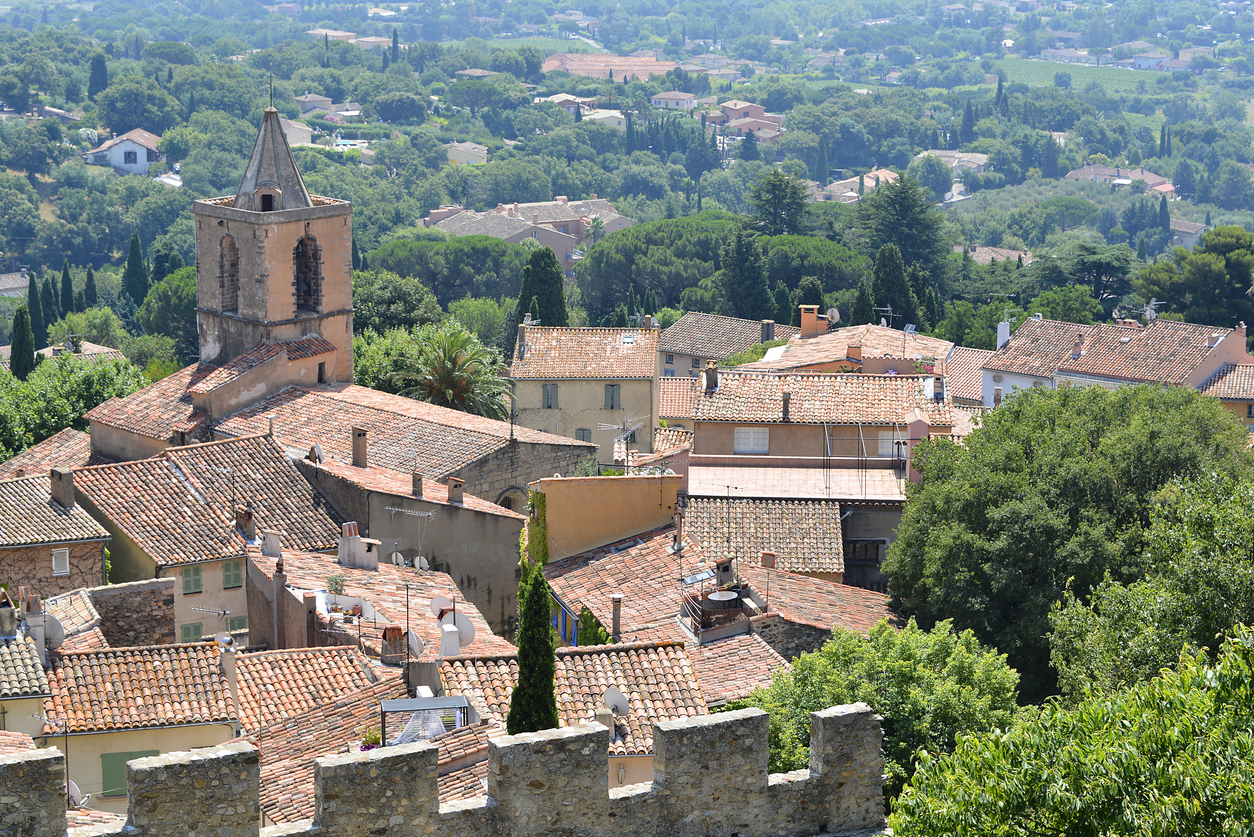
Most Beautiful Photography Spots in Grimaud
Grimaud is one of those hilltop villages that seems sculpted for a lens: stone lanes that twist into secret courtyards, a ruined castle crowning the ridge, and cork-oak woods slipping toward vineyards and the sea. Its visual appeal is timeless, but what makes Grimaud unusually rewarding is how varied the light can be within a compact area—dusky archways in the medieval core, wind-brushed hills around the windmill, and wide horizons that catch the first blush of sunrise over the Gulf.
Before exploring the village through your lens, discover its history, viewpoints and local highlights in our complete guide to Grimaud.
Why Grimaud Captivates Photographers
Grimaud’s beauty isn’t just “old stones and sea views.” It’s a layered interplay of textures and time. The village rises where the Maures hills drop toward the coastal plain, so vantage points come baked into the topography. You can step from a shaded alley into a sudden overlook that makes you reach for a wide-angle, then pivot to a vine-covered door that begs for a 50mm portrait. Within a 20-minute stroll, you’ll cross from medieval tracery to scrubby maquis, and on a clear day the horizon draws a gentle arc that keeps changing color as the wind shifts.
Another reason Grimaud excels for photography is scale. It’s small enough to wander without a plan and still find something to shoot at every turn; yet it’s connected by short drives to a handful of very different landscapes—wetlands, red-rock headlands, and Roman ruins in Fréjus; tranquil coves along Les Issambres; and wide promenades in Sainte-Maxime. You can spend a day with your camera here and never feel you’ve exhausted the options.
Reading the Light: When to Shoot in and around Grimaud
Light in the Maures can be moody. On Mistral days (typically following a cold front), the air is scrubbed clear and contrasty; the coastline pops and mountain ridges stack crisply. This is excellent for long-lens work from the castle or windmill. On humid summer evenings, the horizon melts into pastel layers that flatter portraits in the village lanes. Here are a few local patterns that affect your shooting schedule:
- Sunrise: The castle and windmill ridges receive first light from the east. Arrive 20–30 minutes before official sunrise for blue-hour silhouettes; as the sun lifts, the stone glows and the plain below reveals patchworks of vineyards.
- Mid-morning: The alleys of the old village still hold pockets of shade. This is perfect for detail studies—doorknockers, shutters, climbing bougainvillea—using soft, reflected light.
- Golden hour: The Pont des Fées aqueduct sits in a small valley that catches warm, slanting light at the end of the day. In spring and early autumn, you may still find water under the arch for reflective compositions.
- Night: Summer brings convivial evenings and the occasional event at the castle; cobbles shine after brief showers, and lamplight pools under arches. A fast prime (f/1.8) and a small tripod are your friends here.
Gear note: A polarizer cuts glare on stone and foliage; a 3–6 stop ND makes coastal long exposures easy if you venture to Sainte-Maxime or Les Issambres; and a light travel tripod is invaluable for blue-hour village scenes.
The Château de Grimaud: Ruins with a Riviera Panorama
The ruined castle is the village’s exclamation point. Paths climb from the upper lanes to terraces rimmed with low walls, and when you emerge, the view is wide and immediate: the curving bay in the distance, vineyards like green scales below, and the lumpy spine of the Maures to the west. The stones themselves are photogenic, with broken windows and stair runs that frame the sky.
Where to Stand and What to Carry
From the central village, allow about 10–12 minutes on foot to reach the upper platform. Wear shoes with good grip; the steps can be polished smooth. Two lenses suffice for most castle work: a 24–70mm for context and foreground interest (think: a half-crenellation in the corner leading to the bay), and a short telephoto (70–200mm) to compress rows of vines or isolate sailboats far off. If you arrive before sunrise, start from the eastern-facing bastions; as light builds, drift toward the southwest side for backlit grasses along the walls.
Blue Hour and Summer Evenings
During summer, you may encounter performances or music evenings within the ruins. These nights are magical for handheld shots at higher ISOs (modern sensors handle 3200–6400 gracefully). Aim for candid silhouettes of instruments or spectators framed by the jagged outlines of the castle. If it’s windy, brace against the leeward side of a wall to steady your shot. And always step carefully: the romance of ruins comes with uneven footing.
Lanes, Doors, and Stone: The Medieval Heart of the Village
Grimaud’s center is a web of lanes that invite a slower rhythm. Let the castle wait; spend an hour pacing short distances: a dozen steps, a pause, a look back. The trick is to collect textures and micro-stories: a pale-blue shutter with an iron latch, a doorframe smoothed by palms over centuries, a passageway that opens abruptly to a pocket view of the coastal plain beyond.
Rue des Templiers and Rue des Arcades
These two lanes hint at their past in their names. Early morning is best, when the stone retains a night-cool tone and the light bounces gently. Look down: the paving stones differ from stretch to stretch, sometimes with a herringbone pattern that leads the eye. A 35mm or 50mm prime is ideal for tight compositions that exclude modern clutter; kneel to align lines, and wait for a passerby in neutral tones to anchor scale.
Place Vieille and Its Fountain
This small square sits in soft light much of the day, thanks to shade from a mature plane tree. The fountain’s rim makes a natural frame—shoot low across it to catch the shimmer of water with façades beyond. Arrive early if you want the square without people, or embrace human presence: a child’s hand on the fountain edge, a local pausing with a baguette. If you’re into reflections, a small puddle after a sprinkle turns the flagstones into a patchwork mirror.
Colors and Plants: Bougainvillea and Wisteria
By late spring, bougainvillea pours over walls in magenta cascades, and wisteria hangs like lavender smoke from pergolas. Rather than shoot them straight-on, look for how they spill into an alley corner or brush a frame around a shutter. A close-focus 85mm works beautifully here; backlight the leaves near dusk for a translucent glow. Watch for painted doors—sage, terracotta, and duck-egg blue are common—and let color relationships carry the scene.
The Old Washhouse and Quiet Corners
Just below the busier squares, Grimaud hides an old stone lavoir (washhouse). The basin, often still and shaded, invites a simple reflection shot: half water, half wall. Use manual focus to nail the surface plane and a polarizer to control sheen. Nearby, short passages—sometimes only two or three houses long—offer arches where you can shoot a series of diminishing doorframes, a classic composition that never feels tired when the stone is this beautiful.
Pont des Fées: A Medieval Aqueduct in Its Green Hollow
Down a signed footpath from the village edge lies the Pont des Fées, the “Bridge of the Fairies.” It’s an old aqueduct spanning a shallow, wooded ravine, with moss and fern details that push you toward slower shutter speeds and tripod work. In spring, water trickles beneath; by late summer it may be dry, which opens up new angles from the streambed.
Compositions to Try
Approach from the upstream side and look for a three-layer stack: mossy foreground stones, the arch mid-frame, and a hint of sky beyond. Move a step or two either way; the curve warps pleasingly through a 24mm. If there’s water, start at 1/4s and drag the shutter to blur the flow; if it’s dry, find leaf patterns and shoot for maximum texture at f/5.6–f/8. The arch also frames portraits beautifully—stand your subject two meters inside the shade, face angled toward the light from the ravine mouth for soft, sculpting contrast.
Light and Safety Notes
The valley gets shadow early. If you want warm light on the stones, arrive in the last hour before sunset in spring or autumn. After rains, the path can be slick; stick to the main track and avoid scrambling the steeper banks. Respect the site—keep to marked footways, and resist the temptation to climb the arch itself.
Moulin Saint-Roch and Chapelle Saint-Roch: Wind and Stone on the Ridge
Just above the village, a restored windmill and a small chapel mark a knuckle of the ridge. The setting is open, with low brush and shallow soils that grow summer grasses like straw. The mill’s silhouette against the sky is a clean graphic, especially in profile. If the Mistral is up, expect the sails to be stilled but the air gloriously clear—perfect for minimalist compositions with a deep blue dome above.
Angles and Alignments
Walk a slow circle around the windmill. From the north-northeast, you can align the mill with a swathe of vineyards below, letting the cone stand like a sentry above the patchwork. From the west, the chapel joins the frame, a stoic counterpoint to the mill’s roundness. Bring a short telephoto to pull them closer together, or go wide and place a tuft of thyme or a rock in the foreground to lead the eye. Late afternoon glances warmly off the mill’s stone; in winter, the low sun gives you long shadows to play with.
Sacred Stones: Église Saint-Michel and Notre-Dame de la Queste
The 12th-century Église Saint-Michel anchors a quiet square with photogenic austerity. Its Romanesque lines are clean and balanced, with a simple portal that begs for symmetrical framing. Inside, the cool, dim interior calls for higher ISO or a tripod if permitted; details—the curve of a capital, a candle’s glow—reward slow looking.
Just outside the village, in a meadow swaddled by cork oaks, stands the Chapelle Notre-Dame de la Queste. The setting is pastoral rather than urban; in mid to late summer, the light turns honeyed across the clearing. Step back and let the chapel sit low in the frame, a counterweight to the canopies. On certain days in August, a traditional gathering brings horses and locals to the meadow, a fine opportunity for respectful documentary images.
Vineyards and Cork Oaks: Rural Scenes around Grimaud
Between the village and the main road that threads toward the coast, you’ll pass tidy rows of vines, flat light shimmering off the leaves by midday, deepening to a bronze reflect in the evening. To the west, cork oaks rise with gnarly posture; some show the deep orange blush of a recent harvest. Rural scenes here are about pattern and patience.
Where to Look and What to Watch
On the approach roads framing the village, you’ll find pull-offs where you can safely step out and line up the vines against the hill. Look for rows that gently converge toward the bell tower or castle above—a pleasing forced perspective. After rain, small puddles along dirt tracks reflect rows and clouds for simple, graphic shots. The local wine cooperative along the main road is a useful landmark that signals you’re close to expansive vine vistas; around harvest, mid-September, you may find crates stacked at parcel edges, adding touches of color and human scale.
Backlighting and Detail
Late afternoon backlighting rims the leaves with silver. Stop down a little (f/8–f/11) to keep both near leaves and distant hill in fair focus, and let the sun fringe the edges. Alternatively, go close: cork bark is a world in itself, all furrows and shadows. A macro or close-up filter lets you abstract small sections into portraits of texture. If you do photograph workers at harvest, keep a polite distance and ask first; a smile and a few words go a long way.
The Maures Trails: Forest Textures and Horizons
Once you leave the last houses, the landscape tips into the Massif des Maures—heather and cistus, arbutus (strawberry tree) and myrtle, their scents peppering the air. Trails loop from the village edge toward small ridges; none are alpine epics, but each bend offers a different patchwork of shrubs and distant views. The seat-of-the-pants strategy works here: walk fifteen minutes, stop, and frame the world through the nearest cork oak.
Two Short Walks to Photograph
First, the loop that connects the village to the Pont des Fées and back up via a different path. This circuit gives you a sequence of cool ravine, mid-slope scrub, and finally rooftop views. Second, the ridge walk from near the windmill: keep to the crest and let the horizon do the work. On winter afternoons, the sun low in the southwest cuts raking shadows across shrub tufts that look like black calligraphy against pale sand.
Flora Close-Ups
In late winter, mimosa splashes yellow in pockets near the lower slopes; in spring, cistus blooms star the paths in white and pink. The arbutus bears fruit in autumn—little red-orange spheres with a fine texture that pop against glossy leaves. Keep compositions simple: isolate a single bloom against distant bokeh. If the wind is up, nudge your shutter faster to 1/500s and bump ISO; the plants here rarely hold still for long.
Framing the Gulf: Distant Horizons from Grimaud Heights
While Grimaud sits back from the water, its heights provide sweeping sea views. On the brightest mornings, aim east-southeast from the castle ramparts and watch the curve of the bay catch first light. In late summer haze, the horizon goes milky and romantic; in crisp winter air, edges sharpen and boats pop like paper cut-outs. Long lenses compress the distance beautifully, turning terraces, orchards, and sea into a tight, layered composition. If you carry a small set of graduated NDs, they’ll help hold sky contrast without sacrificing the midtones over the plain.
To discover more villages, beaches and viewpoints around the bay, explore our Gulf of Saint-Tropez travel guide.
Markets, Artisans, and Everyday Life Scenes
Village photography thrives on the quiet, unscripted moments of daily life. On Thursday mornings, Grimaud’s weekly market brings a measured bustle to the squares. Stalls pile with goat cheeses, olives, and strawberries in season—ripe subjects for color and texture studies. Work from the edges: frame hands exchanging coins, a vendor’s chalkboard, or the interplay of baskets and checked tablecloths. Step back for wider frames as locals chat in the shade beneath the plane trees; the rhythms here are easygoing and respectful of a camera that doesn’t intrude.
Across the bay in Sainte-Maxime, the morning rhythm hums along waterfront quays and the streets behind them. Between errands and espresso, there are chances for candid urban vignettes: a bicycle leaning against a stucco wall, a newspaper folded on a café table. Keep your shutter discreet and your framing intentional; the best images feel like glimpses rather than grabs.
Nearby Coastal Light: Sainte-Maxime to Les Issambres
If you want to pair Grimaud’s stone with the sea’s motion, two short drives unlock very different coastal moods. Both spots are easy half-day add-ons to a Grimaud-centric shoot and reward sunset seekers.
Pointe des Sardinaux, Sainte-Maxime
This low, rocky point feels like a natural classroom in composition. A narrow isthmus leads to a flattish platform pocked with tide pools; among them, old concrete moorings and small pine silhouettes give you anchor elements. Arrive an hour before sunset to scout. Drop a 6-stop ND at last light and run 2–4 second exposures to soften small waves into glass around the rocks. A microfiber cloth helps when sea spray joins the wind. There’s little elevation here, so foreground interest is key: a spiral of foam, a drift of seagrass, the cracked geometry of the rock itself.
Les Issambres Calanques and the Gaillarde Tower
Further west, the coast breaks into a run of small coves and folds. The layered strata angle into the water, setting perfect diagonals for dynamic frames. Short scrambles lead to perches above the calanques; shoot along the rock planes toward open water for clean lines. Near La Gaillarde, a historic watchtower presides over the coast; a 70–200mm lets you pair the tower with breaking light off the sea. Cloudy evenings often break late here; wait it out, and you might be rewarded with sunbeams sliding under the cloud deck.
Wetlands and Roman Stones: Saint-Aygulf and Fréjus
The coast and hills tug the eye, but another kind of light waits just beyond: reedbeds and old Roman work. Both are easily folded into a Grimaud itinerary when you feel like changing textures.
Étangs de Villepey, Saint-Aygulf
The Villepey ponds spread behind the dunes, a net of inlets and reedbeds that hold stillness even on breezy days. Birdlife is the draw—egrets, herons, and waders that hunt the shallows. Early morning gives you soft light and calm water; a 300mm or 400mm reach is handy. If you’re not a birder, focus on patterns: reed reflections in low contrast, the repeat of posts in the shallows, or the zigzag of boardwalk shadows. On certain mornings, a slight mist hangs over the water and begs for minimalist frames.
Fréjus: Amphitheatre, Aqueduct, and the Malpasset Dam Ruins
Roman Fréjus offers details and grandeur in equal measure. The amphitheatre’s curves read beautifully in high, directional light; aim for late afternoon when shadows wrap the seating tiers. Remnants of the aqueduct stand in fragments—use a wide lens to place an arch strong in the frame with modern life sensibly absent. For a wilder mood, the Malpasset dam ruins, tucked in the hills north of town, are solemn and striking. As the sun slides across the broken concrete and stone, surfaces come alive; a 35mm captures human scale against the massive forms, while a telephoto abstracts rebar and cracked planes into geometry.
Seasonal Color Palette: How Grimaud Changes Mood
Each season clocks a different tempo through the village and its surrounds, and your images will carry that mood if you work with it.
- Winter: The air turns glassy after cold fronts; the castle’s stones sing under that clarity. Morning frost in the vines is rare but unforgettable; watch for it on valley bottoms. Midday light is softer than in summer, so even noon can work if clouds scatter brightness.
- Spring: Wisteria drips from pergolas in April, and new vine leaves sparkle lime-green. The Pont des Fées often runs with water, and meadows near the Queste chapel take on fresh hues. Rain showers pass quickly; keep a lens cloth handy and look for rain-wet stone.
- Summer: Bright, long days push you to edges—early and late. Bougainvillea, open shutters, deep shade. Night scenes get lively; a tripod and patience repay in spades.
- Autumn: The vines bronze and russet; cork oaks drop leaves sparingly, opening light into the understorey. Lower sun angles extend the golden hour, and morning mist sometimes settles in folds below the village.
Practical Photo Tips Specific to Grimaud
Photographing Grimaud is simple logistically, but a few small choices make your day smoother and your images stronger.
Getting Around on Foot
Park near the edges of the old village and wander in—walking is the only sensible way to absorb the place. From the village center, it’s roughly 10 minutes up to the castle, 5 minutes more to circle to the windmill and chapel. The Pont des Fées path begins from the outskirts and descends gently; budget 15–20 minutes each way.
Smart Gear Choices
Two lenses cover 90% of scenes: a midrange zoom (24–70mm) and a short tele (70–200mm). Add a fast 35mm or 50mm for interiors and night alleys. A polarizer pulls color from stone and leaves; a small ND stack helps at the coast. A compact tripod—carbon if you have it—makes blue-hour and night shots steadier without weighing you down. Pack a spare battery; live view in the evening drains faster than you think.
Respectful Shooting
Grimaud is a living village. If you’re drawn to a private doorway or garden, ask; a simple “Bonjour, puis-je photographier?” works wonders. Avoid flash in churches unless clearly allowed, and step quietly through services. Drone rules along the Riviera are strict and frequently updated; assume no-fly in the village core and near gatherings. On trails, keep to marked paths—erosion is real on these fragile slopes.
Sample Half-Day Photo Itineraries
Two simple frameworks help you catch the village in its best moods without rushing.
Grimaud Sunrise to Sunset Loop
- Blue Hour at the Castle: Arrive 30 minutes before sunrise; start on the east-facing terrace for silhouettes, then turn as the sun warms the stones.
- Village Details and Coffee: Descend into the lanes for doors, shutters, and courtyards. Take a mid-morning pause at a café on one of the shaded squares; keep your camera out for quiet street scenes.
- Afternoon Ridge: Walk up to the windmill and chapel; work slow telephoto frames of the village beneath the sails, then step back for wide shots with foreground grasses.
- Golden Hour at Pont des Fées: Drop down to the aqueduct an hour before sunset; experiment with long exposures if water runs, or focus on rock and fern textures in oblique light.
- Night Lanes: Return to the village for lamplit alleys. Let 1/15s–1/30s handheld blur footsteps just enough to imply motion without losing faces.
Stone and Sea: Grimaud plus a Coastal Sunset
- Late Morning in the Village: Work courtyards and the church interior while light is gentle.
- Windmill Midday: Minimalist sky-and-sails studies; let shadows play.
- Drive to Sainte-Maxime: Scout Pointe des Sardinaux; mark two or three foregrounds.
- Sunset Long Exposures: As light fades, bracket exposures and swap in ND for 1–4 second blurs; end with blue-hour stills when the first stars appear.
Textures to Collect: A Photographer’s Checklist
When a place is as visually generous as Grimaud, it helps to set micro-goals. Challenge yourself to “collect” a few of these in a single day:
- A hand-carved doorknocker framed with flaking paint
- A fountain detail where light skims the surface like silk
- A windmill profile with a single pine clouding the horizon line
- A vine row converging toward the hilltop stones
- A cork oak close-up where shadow carves the bark into relief
- A reflection in the lavoir that reads as almost abstract
- An archway portrait at the Pont des Fées
- A market vignette with just hands, produce, and a hint of chalkboard script
- A distant, layered sea view compressed with a long lens
- A night alley where one doorway glows and the rest recede
Eating and Pausing: Photogenic Breaks
Photography days need pauses, and in Grimaud those pauses are often scenic. The squares under the plane trees are naturally photogenic, especially mid-morning when light filters through the leaves in dapples. Simple espressos, a slice of tarte from a local patisserie, or an afternoon glass of rosé on a shaded terrace offer both rest and casual subjects—cups, saucers, and glassware catching the light over stone tables. If you enjoy food photography, keep your lens modestly wide and work with natural light; turn plates toward the window or the open square and let the background fall into gentle blur.
Working the Weather: Mistral Days vs. Hazy Evenings
Weather is expressive here. When the Mistral blows, count on deep blue skies and long-reaching views. This is the moment for stark, uncluttered frames—windmill against sky, castle stones and sharp horizons, long-lens compressions of vineyards. When haze sets in (often in August afternoons), switch tact: lean into soft tones, shoot into the light to milk the glow, and favor portraits and details in shade. Wet days shouldn’t scare you off; rain saturates color in stone and plants, and empty streets open elegant compositions you won’t find in full sun.
From Light to File: Small Workflow Choices with Big Impact
A few on-the-spot habits help you translate Grimaud’s richness into strong final images:
- Expose for highlights in high contrast; you can lift shadowed stone easily, but a blown sky over the bay won’t forgive.
- Set a custom white balance off pale stone when shooting alleys; it’s neutral and helps you avoid the yellow cast of lamp-lit shade.
- Bracket subtlely for coastal sunsets (±1 EV); merge only if needed, or choose the single frame with the most convincing mood.
- Cull lightly at lunch, not in the evening; you’ll keep your night eyes and your momentum for blue hour.
Small Signs You’re in the Right Place
One pleasure in Grimaud is learning to notice the subtle markers of place. House numbers in hand-painted tiles with Provencal motifs, wrought-iron hinges that curl like vines, and small, weathered plaques telling a building’s story are all cues you can weave into your frames. On steps, look for little sprigs of thyme or wild fennel poking from cracks; on sills, terracotta pots chipped just so. These are the gentle signatures that tell viewers they’re somewhere specific, not just anywhere old and pretty.
Ethics, Access, and a Good Goodbye
Photography here is welcomed when it’s considerate. If you’re shooting before breakfast or after dinner, keep voices low; sound carries in stone alleys. If a door is ajar, it’s still a door—don’t lean in, and don’t publish images that invade private space. On the trails, pack out everything. At the end of the day, a quiet lap through the lanes—camera away—helps you memorize the light without trying to capture it. Paradoxically, those unphotographed moments often sharpen your eye for the next day.
Pulling It All Together
Grimaud rewards slow attention—of light, of texture, and of the tasteful way landscapes meet village forms here. Start at the top with the castle’s clean lines and long views; spiral down through alleys where centuries have softened the edges; and step out toward the aqueduct and windmill, where wind and time show on stone. Build in a small detour to the coast or wetlands if you want new textures. But most of all, return to the same corners in different hours. The village will keep changing for you, and your images will deepen with it.
Looking for the perfect base for your photography trip? Discover our holiday villas and holiday homes in Grimaud.

