

 EN
EN  NL
NL
 DE
DE
 FR
FR

Most Beautiful Photography Spots in Sainte-Maxime
The first light in Sainte-Maxime arrives quietly: a silver band widening over the Gulf, the perfume of pine loosening on the air, fishing skiffs nudging each other in the harbor. It’s an easy town to love through a lens. Everything sits at a comfortable human scale—lanes of warm plaster and blue shutters, promenades designed for strolling, beaches that unfold from rocky coves to long arcs of pale sand. The best images here aren’t only the headline views across to Saint-Tropez; they’re the textures—rope coils on the quay, ochre walls flaring at sunset, shadows of palm fronds printed onto paving stones. This guide maps the most rewarding places and moments to photograph in Sainte-Maxime, with the kind of details you’d share with a friend on their first serious shoot in town.
Before exploring the town through your lens, discover its beaches, attractions and local highlights in our complete guide to Sainte-Maxime.
Understanding Sainte-Maxime’s Light and Seasons
The Gulf of Saint-Tropez shapes the way light behaves in Sainte-Maxime. The town faces mostly south-southeast, so dawn opens along the right-hand sweep of the bay, and evening light flattens into soft gold from the west. The sea amplifies it all—on clear winter days after a mistral the colors pop like glass; in late summer you get pearly washes that flatter skin tones and sand alike. If you understand this rhythm, you can time each location for its best version of itself.
Sunrise vs. Sunset: Reading the Bay
Sunrise belongs to the eastern edges: Pointe des Sardinaux, La Nartelle, and the Préconil side of town. From the Sardinaux headland you watch a low sun skim the water, lighting the rock pools from within. Over on Plage de la Nartelle, early light rakes the sand into long striations and trims the gentle swell with metallic seams—beautiful for minimal long exposures. Sunset tilts the other way: the Old Town’s plaster flares, the harbor gets mirror-like reflections of the sky behind you, and from the promenade near the Tour Carrée the last rays kiss the green lighthouse at the breakwater’s tip. Blue hour lingers over the Pont du Préconil, where cables and pylons silhouette perfectly against a rose-blue sky.
The Mistral and the Cleanest Air of the Year
When the mistral blows—a cool, dry northwesterly—the sea stands up in flecks of white and the air is rinsed clear. Colors jump a stop brighter, the horizon snips to a crisp line, and distant details across the Gulf suddenly look close enough to touch. Work wind into your frames: pines splayed shoreward at Sardinaux, spray pluming off the rocks, flags on the harbor railings arrowing the composition. On mistral days, shoot with your back to the gusts where possible and brace the tripod low—this is when panoramic stitches from hill viewpoints like Chemin du Sémaphore are at their most detailed.
Seasonal Shifts: From Mimosa to Late-Summer Haze
January–February brings mimosa bloom—puffs of citrus-yellow lighting up slopes behind town and garlanding roundabouts and promenades. It’s a painterly counterpoint to the cool blue sea. Spring softens the light and greens the Aleppo pines; the Jardin Botanique des Myrtes becomes a macro playground. High summer’s heat and humidity flatten contrast—ideal for portraits in open shade and for water abstracts at midday. Autumn returns angles and clarity; the Gulf warms enough to stay in the sea between sets, and sunsets stretch longer. Each season shifts not just the scene, but your technique: polariser in spring, ND filters in summer when you want motion, maybe a fast prime for low winter sun.
Old Town Lanes and Market Life
Begin in the Vieux Village, where streets hold their cool even at noon. The old grid sits just behind the waterfront, threading from Rue Hoche and Rue de la République into a run of pocket squares. Look for shutter stacks in faded blues and greens, wrought-iron balconies with glazed pots, and the kind of doorways that beg for a frame-within-a-frame portrait. Mornings are best, when delivery carts squeak and bakers open up; late afternoon comes alive with oblique light carving shadow ribbons along the plaster.
Rue Hoche and Neighboring Alleys
Rue Hoche is the town’s shorthand for warmth: terracotta façades, hand-painted shop signs, the occasional trompe-l’œil window. Turn off immediately, though. The narrower lanes—Rue de Verdun, Rue Paul Bert, and the streets radiating from Place du Marché—offer better depth and the kind of leading lines you can anchor with a lone passerby. Shoot wide at knee height to exaggerate the paving stones, or go longer from a corner to compress balconies and awnings into a patterned facade. On hot days, subtle heat shimmer at the end of the street adds a cinematic haze that looks fantastic in color and moodier still in monochrome.
The Covered Market near Place du Marché
Follow your nose toward the covered market just off the main square. It’s best mid-morning, when produce is at its glossiest and light leaks through doorways at a satisfying angle. Ask before you frame the fishmongers—most are fine with it if you move quickly and don’t block the queue. Photograph hands: change counted, bread bagged, a knife draw against a fig. Step back for stall-wide color studies—eggplants, tomme wheels, and bouquets of aromatic herbs—then switch to a shallow depth of field to isolate pattern within pattern. Outside, the square’s café terraces give you a stage for candid street: regulars leaning back in woven bistro chairs, espresso saucers catching tiny highlights, and the ever-present dog napping under a table.
Details to Hunt: Stories in the Small Things
Make a checklist you can run without thinking: door knockers shaped like hands, sun-faded house numbers stenciled on stone, shutter hooks that read as punctuation marks against a wall. In the Old Town, signage leans artisanal—painted cursive on wood, gilded letters peeling gracefully. Capture patina. When light gets too harsh, duck under awnings and shoot reflections in shop windows; layer passersby into the glass to blend inside and street life. If you love still lifes, the fruit stands’ crinkled paper trays and bundles of thyme and laurel are pure Provence in a single frame.
Tour Carrée and the Waterfront Axis
At the hinge of town and sea stands the Tour Carrée, a square 16th-century watchtower now home to local heritage exhibits. Even if you don’t step inside, walk its perimeter: coral-tinted stone blocks stack into clean geometry, weather pocks catching side light beautifully. From here the waterfront unfolds: the marina to one side, the long promenade to the other, and in front of you that bright strip of Gulf water where the light is always busy making something photogenic.
Square Bonaparte: Elevation, Lines, and Shade Sails
Square Bonaparte rises just above the waterfront like a viewing deck stitched to the town. The white shade sails tension into graceful triangles, casting geometric shadows that change by the hour. Use them. Climb to the upper terrace and shoot down toward the port to compress masts into a forest of verticals. Or turn back to town and let the sails’ diagonals lead the eye toward the church spire and the pale blocks of the Old Town. Evening here is superb: street lamps warm the stone, families wander through, and the sails become translucent kites against the sky. It’s also a comfortable place to wait for light shifts, with benches ideally placed for lazy framing.
The Harbor Breakwater and Green Lighthouse
The long curve of the breakwater funnels you toward a classic Mediterranean punctuation mark: a slim green lighthouse at the tip. Walk the jetty at dawn or blue hour. In the morning, a telephoto can pull the lighthouse tight against pastel water, a gull mid-flight giving scale. At dusk, mount a small tripod against the inner wall, dial in a short long exposure to slight-smear the water, and time your shot between walkers. If ferries are running, their wake carves clean V-shapes in the harbor—catch one just before it breaks for a dynamic foreground.
Pont du Préconil and the Eastern Promenade
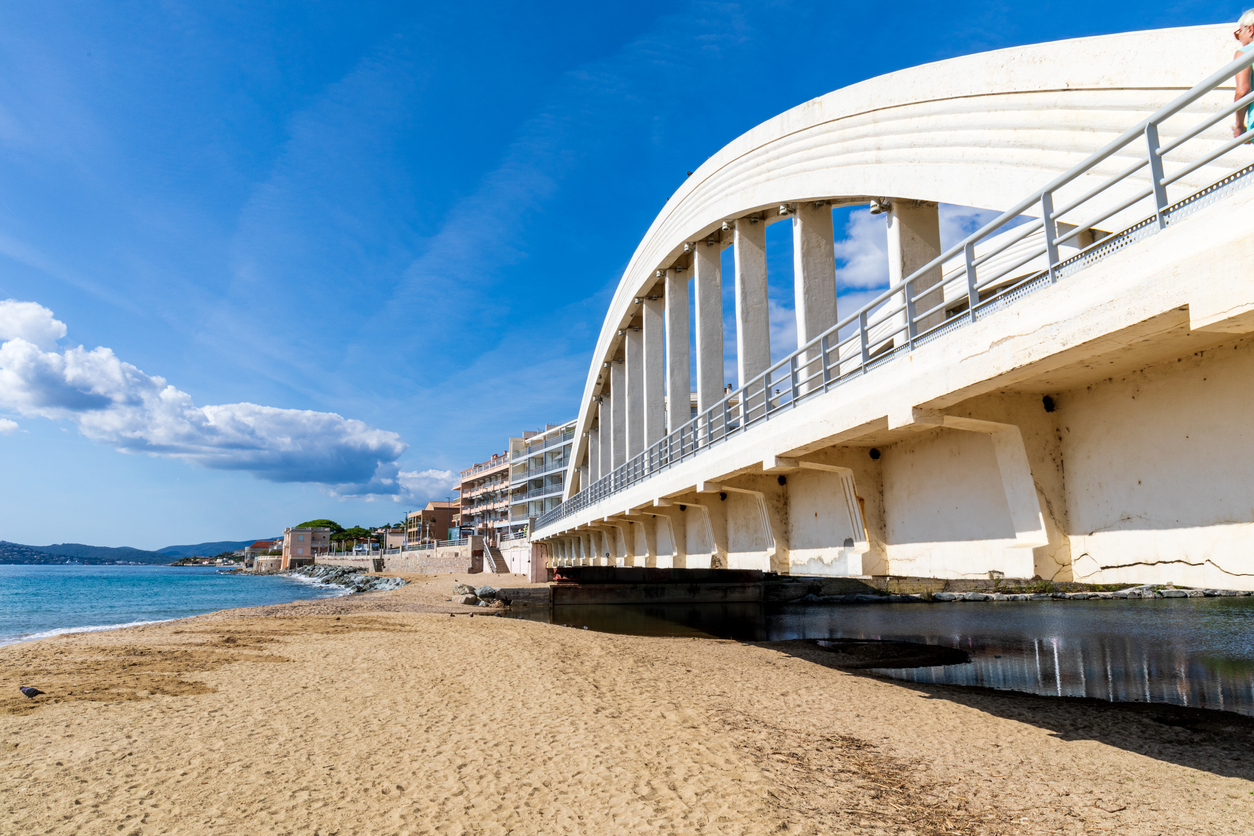
At the town’s eastern end, where the Préconil stream meets the sea, a modern footbridge strides the water with sculptural simplicity. It’s one of Sainte-Maxime’s most graphic structures—crisp white lines, cables singing diagonals, a river surface that turns to mirror on windless evenings.
Reflections and Blue Hour Symmetry
Arrive twenty minutes after sunset. Stand mid-span and align the bridge’s mast with the horizon so your frame splits into layered bands of color—deepening cobalt above, warmer blushes near the sea, and the first streetlights scissoring gold across the water. On still days, the reflection doubles the geometry. Shoot a series at different shutter lengths: 1/10 for the softest smear of a jogger, 1–2 seconds to smooth ripples, 8–10 seconds if you want river glass. Bring a cloth; sea air mists lenses faster here than you expect.
Morning Energy in Motion
Early morning, the promenade that runs back toward town fills with runners, dog walkers, and cyclists. A low angle with a 35mm or 50mm captures movement compressed against the gulf and the outline of the Old Town. Use shutter priority and pan—1/30 sec gives a lovely sense of motion while keeping faces anonymous. The pylons of the bridge frame well for portrait sessions too: crisp white, clean light, and the sea as ever-shifting backdrop.
Jardin Botanique des Myrtes
A short sea-hugging walk from the center brings you to the Jardin Botanique des Myrtes, a small botanical garden with Mediterranean and subtropical plantings. It’s quiet, shaded, and intricately textured—ideal when midday sun is too blunt elsewhere. Palms lace the sky, myrtle hedges give the garden its name, and walking paths offer repeated compositional elements for portraits, detail studies, and macro play.
Macro Stories and Plant Portraits
Leave the big zoom in your bag. Mount a macro or a prime that focuses close, set aperture around f/4–f/5.6, and treat leaves and fronds like faces. Go hunting for backlit translucence—banana leaves glow lime green, cycads cut sawtooth silhouettes against the sun. Water droplets from morning irrigation make easy bokeh; check the undersides of leaves and the seams of flower bracts for miniature worlds. If you’re with a human subject, the garden’s benches give instant compositional anchors without visual clutter.
Dappled Light for Human Subjects
Dapple can be tricky, but here it’s soft and regular under the bigger canopies. Use it to paint portraits: expose for skin and let background highlights bubble away. The garden’s paths curve gently, so you can stage a subject just off-axis to create depth without drama. For lifestyle details, photograph shoes scuffing gravel, a hat brim tilted against the sun, hands folded over a guide leaflet. These in-between gestures often tell a truer travel story than the postcard view.
Pointe des Sardinaux: The Wild Tip Locals Love
Ask a Maximois where they go to feel the elements and they’ll point you to the Sardinaux peninsula—nicknamed “Little Corsica” for its low, fragrant pines bent by wind and a rocky fringe scalloped with pools. It’s arguably the town’s best sunrise stage and a first-rate place to practice compositional restraint.
Rock Pools, Blockhouse, and Tidal Texture
At low water, the limestone shelves puzzle into infinity pools, each holding a different sky color. Get low, as close as you dare without soaking your camera, and use a 24–28mm to exaggerate the near-far drama. A WWII-era blockhouse perches above the rocks—its brutal lines make a stark counterpoint to the organic curves around it. Frame it tight with the pine canopy or wide with sea and sky; both read as strong. Watch your footing: the darker rock can be slick with algae.
Sunrise, Motion, and the Sound of the Sea
Sun comes up along the peninsula’s shoulder, so you can place it as an edge light rimming pines or as a clean orb lifting from the water. Bring an ND filter if you like long exposure silk; 0.6 to 0.9 is usually enough with tripod legs splayed low among the rocks. On breezy mornings, the sea chews at the headland—compose to catch those diagonal lines of foam that lead back to your subject. Leave time after you’re “done” to simply sit and listen; more than once, that’s when a gull ride or a fisherman silhouette turns the morning into a keeper.
Winter Swell and Safety First
When swell is up, waves can slap higher and faster than they look from the car park. Scout with eyes on the ocean, keep gear in a backpack rather than slung at hip height, and never stand on dark, perpetually wet rock. It’s the kind of place that rewards humility; the biggest compositional gift of a wild morning is sometimes a simple spray feathering into first light.
Plage de la Nartelle and the Curve to La Madrague
East of town, Plage de la Nartelle arcs in a long, breathing sweep of pale sand, backdropped by pines and low villas. It’s the counterbalance to the rocky drama of Sardinaux: here, compositions read best as graphic simplicity—horizons, slender surf lines, silhouettes of morning swimmers.
Minimalism and Water Sports
On calm summer mornings, the bay turns to lacquer. Set a modest telephoto and compress horizon and swimmer until they’re pieces of punctuation in a sea of blue. Later in the morning you’ll get stand-up paddleboarders and the odd foil board skimming by—great for panning practice. In the shoulder seasons the beach is spacious and the light long; use footprints as leading lines toward the sea, or place a lifeguard flag to anchor the frame against the horizon.
Unhurried Breaks at Simple Beach Cafés
Between sets, a coffee or citron pressé at one of the low-key beach cafés on the sand buys you time to watch the light rotate. Don’t overlook the photographic potential in your glass sweating on the table, a straw cutting a blue stripe against the sea, or a plate of sliced melon catching rim light. These pauses often yield images that tie a day together with human scale.
Golden Hour People Watching
Late afternoon, backlight turns every salt spray into glitter and edges shoulders and hats with a thin aureole. Control flare with a raised hand and expose for the highlights; silhouettes at Nartelle are crisp, with bodies reading as graceful shapes against the banded sea. Keep shutter at 1/500 or faster to freeze spray; it’s a simple trick that often makes the difference between snapshot and “oh.”
Chemin du Sémaphore and Hillside Lookouts
When you want a sense of the whole, climb. The Chemin du Sémaphore switchbacks above the eastern side of Sainte-Maxime through stands of maritime pine and low maquis, with pull-offs that open suddenly onto the full spread of the Gulf. It’s a different vocabulary up here: pine trunks for foreground pillars, the town a mosaic below, the sea bright or brooding depending on the hour.
Framing the Gulf with Pines
Use the vertical rhythm of tree trunks to bracket the bay. A 35mm gives you room to place both near and far; step left or right until trunks align cleanly. If the wind is still, try a stitched pano—three or four frames at 50mm create a detailed sweep that prints beautifully. On clear days after mistral, you can read individual sails across the water; on hazy evenings, the Gulf softens to watercolor. Both are true to the place—let the conditions decide your palette.
To discover more villages, beaches and viewpoints around the bay, explore our Gulf of Saint-Tropez travel guide.
Night Panoramas and Light Trails
After dark, Sainte-Maxime glows in warm constellations: marina lights, seafront lamps, the faint tracing of cars along the coastal road. From a turnout on Chemin du Sémaphore, mount a tripod low and shoot overlapping frames at f/5.6–f/8, ISO 200–400 to keep noise easy to manage. If traffic is flowing, a second frame just for light trails adds a river of red into your composition; blend in post or simply enjoy the single long exposure. The breeze drops a degree or two up here—bring a light layer even in summer.
Sentier du Littoral Westward: Coves and an Elephant
The coastal path that threads westward from town offers a gentler, often quieter side of Sainte-Maxime. Low walls, pine shadow, and small coves where the water is green as glass. Along this stretch you’ll come across Plage des Eléphants, nicknamed after the beloved Babar books—a nod to the area where their creator spent time. There’s a childlike charm to the bay here, with gentle shelves of rock and a strand that reads perfectly in a wide environmental portrait.
Still Water and Sea Grass
Look for patches where the seagrass meadows (posidonia) sway in shallow water; they film beautifully through the surface when the sun is high behind you. A polariser helps you toggle between reflection and see-through clarity. Compose with a sliver of horizon high in the frame, letting the underwater textures occupy most of your image. In the coves, a 35mm set close to the shore turns foam into filigree, with the town’s pastel line whispering at the edge of the picture.
Respecting Posidonia and Access
Posidonia is protected, and those dry tangles on the sand are part of coastal health. Step lightly, avoid trampling dune vegetation, and stick to marked access points. Gates along the path lead to private properties—if a pontoon tempts you, check for signage and ask if anyone is around; many owners are friendly if you’re quick and courteous. A respectful approach preserves access for everyone and keeps the line between public and private clear.
Urban Blue Hour: Summer Evenings by the Sea
When days run long, Sainte-Maxime doesn’t rush the evening. Blue hour feels generous here: the marina settles into glass, families drift along the promenade, and artisan stalls pop up with a quiet, confident charm. It’s a scene built for handheld twilight frames and the kind of color that looks like it’s been graded already.
Square Bonaparte and Pop-Up Rhythm
In summer, Square Bonaparte often hosts small events, from music to open-air exhibits. Even on a quiet evening, the square’s canopied geometry and the slow river of people give you material. Bump ISO to 800–1600, keep shutter above 1/80 for crisp walking shots, and let the first streetlights ink warm pools across the stone. Try a subtle Dutch tilt—just a few degrees—to make the shade sails and lamp posts turn into lively diagonals without feeling gimmicky.
Harbor Reflections and Ferry Movements
As the sky deepens to a deep ultramarine, reflections in the inner harbor intensify. Frame boats as negative space around color: red hulls, yellow rope coils, a lifebuoy circle. If ferries are moving in and out, you can time a 1–2 second exposure to turn their wake into a silk wash that subtly blurs foreground distractions. Rests between shots are half the joy—lean against the marina rail, breathe the iodine-salt mix, and let the evening do its soft work.
Cultural Rhythms That Reward Patience
Photographers who hang back a moment are often the ones who catch Sainte-Maxime’s small, telling gestures. The weekly markets send their honeyed hum into the streets; old friends meet on the same benches at the same hour; an accordion’s softer-than-expected waltz floats from a corner. Work with these cadences, and your pictures will carry the town’s voice.
Weekly Markets and Maritime Moments
Beyond the daily covered market, weekend stalls sometimes spill into adjacent streets with antiques, linens, and all the little things that make Provence domestic life photogenic—linen tea towels, wooden spoons, enamel pitchers. Ask vendors if you can shoot the stall from behind; a seller’s hands arranging goods reads as intimate without being intrusive. Down by the harbor, mornings are best for maritime rhythm: boat maintenance shot at a respectful distance, coils of new rope bright against a deck, a skipper heaving a bucket of seawater across the gunwale. It’s the sea-town grammar, and it looks good in any light.
Mimosas in Bloom and Parade Vantage Points
When mimosa season peaks, town embellishments wear yellow like confetti: wreaths on lampposts, sprigs in café vases, and occasional themed parades that ribbon along the waterfront. For processions, plan a three-stop approach: one wide establishing shot from an elevated spot near Square Bonaparte, one mid-lens human scale frame at street level along Avenue Charles de Gaulle, and one tight detail—a hand holding a sprig, a smile half-sheltered by feathers.
Food Breaks That Double as Photo Sets
In a small town, the café table is a front-row seat. Sainte-Maxime’s food scene is casual, Mediterranean, and light-saturated—terraces with sea glimpses, counters where pastries line up like color swatches, and gelato displays arranged as sculpture.
Morning Pastries as Still Life
Start with a coffee and a slice of a local specialty on or just off Rue Hoche. The window of a bakery or pâtisserie makes an easy set: tarts glazed to high shine, stacks of navettes, citrus peels confited into jewel tones. Ask if you can photograph before you order; most staff are happy about it if you keep the lane clear. Back at your table, shoot the still life: cup, saucer, crumbs, and the blurred clatter of the street beyond. Keep the color palette tight—two or three hues, clean lines—and you’ll have a keeper even before the pastry disappears.
Gelato Color Palettes at Dusk
Evenings on the promenade along Avenue Charles de Gaulle are tailor-made for handheld detail shots: gelati in improbable technicolor, cones stacked in lattices, neon script throwing a soft halo onto faces. Try a candid with a 50mm at f/2–f/2.8, focusing on the hand-to-cone exchange; the sea and lights blur into storybook background. It’s the lightness of a Riviera day turned edible.
Practical Etiquette and Local Respect
Photography opens doors—and occasionally steps on toes—so a light touch keeps you welcome everywhere you go. Sainte-Maxime’s friendliness is part of its charm; match it, and you’ll notice how quickly people relax around your camera.
Beach Clubs, Pontoons, and Private Space
Along La Nartelle and near town, some sections of beach in season are operated by beach clubs with private loungers and small pontoons. The shoreline itself remains public, but the furniture isn’t; if a shot would clearly include private seating areas or guests, a quick nod to staff goes a long way. On pontoons, step carefully—wet planks can be slick—and always yield right of way to people heading for the water. A polite wave with your camera hand and a visible smile smooth nearly every interaction.
Drones, Wind, and Common Sense
The Gulf’s breezes and proximity to active maritime traffic make drones a high-responsibility choice. Check applicable regulations before takeoff, avoid flying over crowds, keep line of sight, and be ready to ground if the mistral wakes. The most lyrical views here are often ground-based anyway—pine-filtered horizons, seawater textures, and a town that reads best at walking pace.
Two Thoughtful Photo Routes
If you prefer a rhythm to your explorations, these two circuits hit strong notes in sequence without trying to do everything at once.
Dawn-to-Brunch: Sardinaux, Myrtes, and the Market
Start predawn at Pointe des Sardinaux. Pick your foreground rock pool, pre-focus, and work half an hour either side of sunrise. When the sun lifts too high for the rocks, follow the coastal path back toward town, pausing for tight studies of pine bark and surf fringe. Continue to the Jardin Botanique des Myrtes for an hour of macro and portrait-friendly shade. As appetite kicks in, swing into the Old Town for the covered market—photograph a quick still life of bread and olives on a bench near Place du Marché, then sit down for a cafetière or juice while you sort your keepers. You’ll have three distinct textures in the bag before noon.
Afternoon-to-Night: Lanes, Square Bonaparte, and the Préconil Bridge
Begin mid-afternoon when light starts to angle, drifting the lanes behind Rue Hoche for shutter-and-façade studies. Slide outward to the Tour Carrée as the tower turns honeyed, then climb to Square Bonaparte for an elevated look over the marina. Stay put as sunset cools into blue hour, then wander to the Pont du Préconil to work reflections and silhouettes on the bridge. Finish with a slow harbor loop for lamp-lit rigging and the last murmurs of the promenade. If you shoot RAW, you’ll be pleasantly surprised at how much subtle color lives in these twilight frames.
Gear and Techniques That Belong Here
There’s no single kit for Sainte-Maxime, but some tools feel especially at home. Think mobility and control: glass you trust wide open, filters you can dial quickly, and a support you won’t resent carrying.
Filters, Focal Lengths, and a Small Tripod
- Circular polariser: invaluable from mid-morning to mid-afternoon for cutting glare off the gulf and revealing underwater texture along the littoral path. Rotate gently to avoid overcooking the sky.
- Soft ND (0.6–1.2): lets you smooth water at Sardinaux, Nartelle, and the marina without waiting for dusk. Combine with a polariser sparingly; you’ll otherwise chase vignetting at wider angles.
- Focal lengths: a 24–28mm for landscapes and tight lanes; a 35mm as the everyday storyteller; a 50mm or short tele for portraits, details, and compressing the harbor’s verticals. You can do 95% of Sainte-Maxime with two small primes.
- Tripod: a lightweight travel tripod with low leg spread pays for itself at the Préconil footbridge and on the rocks at Sardinaux. Keep a microfibre cloth handy; sea spray is sneaky.
Shoes, Water, and Working the Heat
Grippy shoes matter on wet rock shelves and on the breakwater. A reusable water bottle and a hat make summer reality friendlier. In hot months, shape your day to the light and your comfort: dawn to mid-morning outside, lunch and edit time in shade, late afternoon back to work through blue hour. Batteries deplete faster in cold wind and in high heat; carry a spare and stash one in the shade of your bag rather than in full sun on a table.
Final Thoughts: Where Sainte-Maxime Comes Through the Lens
What makes Sainte-Maxime photogenic isn’t scale or spectacle—it’s poise. The town measures its gestures well. A footbridge that meets the river without fuss. A headland where you can feel the mistral push and still find quiet pools to frame. Lanes where the light tosses coins of gold onto a table just when you’ve set your cup down. If you let it, Sainte-Maxime will teach you to look a beat slower, to leave room in the frame for the air between things, and to build a day around a handful of strong, well-lived moments.
Looking for the perfect base for your photography trip? Explore our holiday villas and holiday homes in Sainte-Maxime.

